
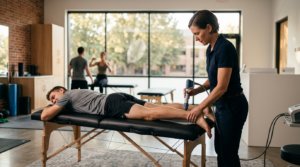
 Extracorporeal shock wave therapy (EWST) is a mechanical therapy that creates local inflammation to promote healing. This therapy creates short bursts of sound waves that create an intense and precise massage to the targeted tissue. Local inflammation is required for all tissues to heal in the body so creating a precise area for the body to send all of its healing elements will speed up the rate of healing. Typically it is recommended to get 6 treatments of shockwave and for optimal results combine it with targeted physical therapy exercises. It’s often used for conditions like tendonitis, plantar fasciitis, and other musculoskeletal injuries that haven’t responded well to traditional treatments.
The mechanism of healing is similar to a commonly recommended procedure called PRP (protein-rich protein) to create local inflammation in the injured tissue to promote healing. PRP is a much more invasive and greater expense as it requires a medical professional to extract blood from a patient and use an element called platelets found in the blood to re-inject back into the injured tissue. Shockwave typically accomplishes the same results in the same 6 week time period as PRP for half the cost.
Shockwave Therapy vs. PRP: A Comparison
Patients often ask how shockwave therapy compares to Platelet-Rich Plasma (PRP) therapy. Both treatments aim to create local inflammation to promote healing, but they differ significantly in invasiveness and cost. Understanding these differences can help you make an informed decision about your care.
| Feature | Shockwave Therapy (ESWT) | Platelet-Rich Plasma (PRP) |
|---|---|---|
| Invasiveness | Non-invasive (no needles) | Invasive (requires blood draw and injection) |
| Mechanism | Sound waves create local inflammation | Injected platelets release growth factors |
| Cost | Generally lower cost | Higher cost due to medical procedure |
| Recovery Time | Minimal downtime | May require short period of rest |
| Safety | A safe, non-invasive treatment | Low risk procedure |
Integrated Care Approach
Shockwave therapy is rarely a standalone treatment. It is often part of a broader plan that may include dry needling, massage therapy, or performance rehab. This integrated approach ensures that all aspects of your musculoskeletal system are addressed. For example, if you have plantar fasciitis, we might combine shockwave therapy with custom orthotics to correct underlying biomechanical issues.
Typical Treatment Protocol
For optimal results, it is typically recommended to receive six treatments of shockwave therapy.
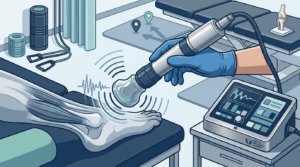 Common Injuries
- Achilles Tendonitis
- Quadriceps/Patellar Tendonitis
- Plantar Fasciitis
- Tennis/Golfers Elbow (medial/lateral epicondylitis)
- Rotator Cuff Tendonitis
- Hip bursitis (Greater Trochanteric Pain Syndrome)
- Hamstring Tendonitis
Who Benefits From Shockwave Therapy?*:
- Athletes
- Active Adults
- Youth Athletes
- Military Veterans
- Women
- People Who Sustained an Injury From an Accident
*Please visit any of our offices to learn more.
“Great sessions with Dr Odoom”. He employed Shockwave therapy to help me make progress in a problem area I have had for over a decade. Very knowledgeable and personable.” – Evan
For more information:
Aqil A, Siddiqui MR, Solan M, Redfern DJ, Gulati V, Cobb JP. Extracorporeal shock wave therapy is effective in treating chronic plantar fasciitis: a meta-analysis of RCTs. Clin Orthop Relat Res. 2013 Nov;471(11):3645-52. doi: 10.1007/s11999-013-3132-2. Epub 2013 Jun 28. PMID: 23813184; PMCID: PMC3792262.
Feeney KM. The Effectiveness of Extracorporeal Shockwave Therapy for Midportion Achilles Tendinopathy: A Systematic Review. Cureus. 2022 Jul 18;14(7):e26960. doi: 10.7759/cureus.26960. PMID: 35989757; PMCID: PMC9382436.
Halpern BC, Chaudhury S, Rodeo SA. The role of platelet-rich plasma in inducing musculoskeletal tissue healing. HSS J. 2012 Jul;8(2):137-45. doi: 10.1007/s11420-011-9239-7. Epub 2012 Jan 18. PMID: 23874254; PMCID: PMC3715623.
Mani-Babu S, Morrissey D, Waugh C, Screen H, Barton C. The effectiveness of extracorporeal shock wave therapy in lower limb tendinopathy: a systematic review. Am J Sports Med. 2015 Mar;43(3):752-61. doi: 10.1177/0363546514531911. Epub 2014 May 9. PMID: 24817008.
Testa G, Vescio A, Perez S, Consoli A, Costarella L, Sessa G, Pavone V. Extracorporeal Shockwave Therapy Treatment in Upper Limb Diseases: A Systematic Review. J Clin Med. 2020 Feb 6;9(2):453. doi: 10.3390/jcm9020453. PMID: 32041301; PMCID: PMC7074316.